Intentional Skinare & Conscious Consumption
Design Research | IStrategy & Innovation | Systems Thinking


Time Period : June '25 - Sept '25
Skintwine addresses the growing tension between self-care and over-consumption in the Indian skincare market. Sparked by my own experience of “product overload”, the project explores why young urban Indian women often feel overwhelmed by skincare choices despite being sustainability-minded.
UAL | Design Management | Graduation Project


“I spend hours researching ingredients, watching YouTube reviews, looking at influencer recommendations on Instagram & reading Reddit threads... but I still don’t know if this moisturizer is actually right for me.”
Her reflection reveals a paradox facing young urban Indian women today: unprecedented access to skincare information has created more confusion than clarity. This demographic—tech-aware, digitally engaged, yet thoughtfully critical, reflects a rising mindset that seeks depth in a space too often dominated by superficial solutions. They crave understanding, not clutter, yet remain vulnerable to overconsumption, decision fatigue, and self-doubt.
Aditi, a 24-year-old marketing professional in Mumbai, captures the exhaustion in her voice as she describes her skincare routine. Despite her cautious, research-driven approach, she finds herself trapped in endless cycles of trial and error.

A broader crisis of intentionality in contemporary Skincare Consumption


Women aged 18–28 in urban India are highly motivated to care meaningfully for their skin yet often struggle to understand its unique needs in relation to lifestyle, hormones, and environmental context. This gap generates emotional strain and contributes to unsustainable consumption patterns.
The issue extends beyond the personal sphere. Skincare overconsumption intersects with global environmental risks — chemical pollution, biodiversity loss, and the release of novel entities, pushing Earth systems beyond safe operating limits, with six of nine planetary boundaries already transgressed. The Earth4All framework highlights how these patterns drive social inequality and ecological overshoot, reinforcing the interdependence of personal wellbeing and planetary health.
Research Question
How Might We enable young urban Indian women to better understand their skin’s real needs and influencing factors, so they can care for it with greater intention, confidence, and contextual awareness— while cultivating both skin literacy and conscious consumption?
Human Centered Design as Research Framework
To explore this further, along with a few others, these 3 core methods were relied on:
1. Semi-structured interviews
2. Thematic analysis
3. Systems mapping
Interviews gave me access to lived realities, capturing nuance and emotion. Thematic analysis, following Braun and Clarke’s approach, helped me surface recurring patterns while still holding space for contradictions. Systems mapping, influenced by Meadows’ work on leverage points, allowed me to place individual struggles within a larger ecological and industrial context.

Guided by Human-Centered Design as my research framework (IDEO, 2015), I employed semi-structured interviews grounded in the COM-B model (Michie, van Stralen & West, 2011) to explore participants’ capabilities, opportunities, and motivations.
Understanding User Realities & Emerging Patterns
Snapshots of Process Work
![SL-072622-51930-14 [Converted].png](https://static.wixstatic.com/media/0dd8bf_2813bf3f0fe845b1852242fffb5ff15c~mv2.png/v1/fill/w_980,h_637,al_c,q_90,usm_0.66_1.00_0.01,enc_avif,quality_auto/SL-072622-51930-14%20%5BConverted%5D.png)
![SL-072622-51930-14 [Converted].png](https://static.wixstatic.com/media/0dd8bf_2813bf3f0fe845b1852242fffb5ff15c~mv2.png/v1/crop/x_1443,y_0,w_20499,h_10896/fill/w_980,h_521,al_c,q_90,usm_0.66_1.00_0.01,enc_avif,quality_auto/SL-072622-51930-14%20%5BConverted%5D.png)

Semi Structured Interviews


Thematic Analysis
Process of doing thematic analysis
3. Key Insights from the Transcripts
1. Individual Codes


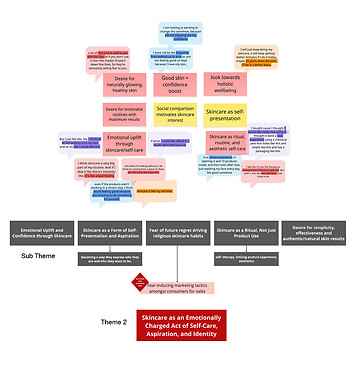
4. Generating Themes and Sub Themes


2. Merged/Consolidated Codes


Insights That Shaped the Problem Definition
Three core themes that emerged from the analysis:
1. Struggles with informed decision-making in noisy landscapes.
2. Skincare as emotionally charged self-care and identity.
3. Craving for meaning and mindfulness in consumption.
Participants repeatedly expressed, “I don’t understand why a product is needed for me.” The emphasis lay in “for me”
— personal relevance in the context of lifestyle, emotions, hormones, and environment.

Data triangulation revealed contradictions with secondary sources. While industry reports characterise Gen Z as hyper-aware and ingredient-literate, participants struggled with ingredient literacy, decision fatigue, and skepticism toward influencers.
Mapping the Forces Behind Skincare Decision-Making
Exploring how personal values, emotional drivers, social and digital influence, and market systems interact to shape everyday skincare choices
Systems Map Snapshot

The broader behavioral issue that emerged was a disconnect between intentionality and capability. This led to my chosen leverage point of
Enhancing Internal Clarity - Helping users build awareness and confidence to make decisions based on their unique skin, context, and lifestyle.
Say Hello to Skintwine!


Skintwine directly addresses the “for me” gap identified in research. Rather than prescribing products, it helps users understand why a product or practice may be relevant to their unique skin in the context of their lifestyle, emotions, hormones, and environmental factors.

Skintwine is a hybrid toolkit featuring:
A weekly physical calendar with daily icon-based covering skin condition, mood, sleep, cycle, hydration and dietary triggers. Users employ dry-erase markers on the glass for 2-minute daily input with weekly reflection spaces.
Its digital mobile app syncs weekly photo check-ins with existing health data (cycle, sleep, fitness, weather) to visualize how daily life affects the skin. It then provides simple weekly pattern summaries and gentle, non-prescriptive reflections to support awareness and informed decision-making.
Skintwine: Concept Walkthrough
User Flow illustrates the step-by-step journey within the toolkit
.jpg)
.jpg)
Validation & Impact Assesment for Skintwine
The impact measurement methodology for Skintwine will combine quantitative and qualitative indicators.
Quantitatively, success will be measured by 60% of users consistently engaging with the tool for over one month and 80% reporting greater clarity in recognising their skin triggers and patterns. Qualitatively, impact will be assessed through users’ self-reported improvements in decision-making confidence & sustainable consumption habits.
Skintwine envisions scaling from individual empowerment to systemic transformation.
In the short term (1–2 years), the hybrid toolkit offers a behavioral entry point for urban Indian women.
Medium-term (3–4 years), it expands across demographics, integrates with health and lifestyle applications, and embeds ecological metrics.
Long-term (5+ years), it becomes a community-oriented platform where anonymized data fosters peer learning, informs sustainable product design, and contributes to policy discourse.
